
Custom real estate agent websites.
For solo realtors who want to keep their leads instead of routing them to Zillow. No IDX widget by default. No templated SaaS lock-in. A site that's actually yours, designed around your market and your audience.
Most realtor sites are working against you.
Open any major realtor platform — Placester, RealGeeks, Luxury Presence — and look at the demo sites. They're the same site. Same layout, same hero image style, same IDX widget that dumps your visitor into a search experience designed to route them off your domain and into the platform's lead-routing system. You pay $50-$500 a month to send your traffic to your competitors.
The other option agents usually consider is the cheap end: Squarespace or Wix. Those sites look fine and they're honest about what they are — a brochure. But they don't rank, they don't have schema, and they don't support the kind of content marketing that brings buyers to a solo agent's site organically.
There's a third option that almost nobody is building, and it's the one that actually works.
Neighborhood guides instead of IDX. Schema instead of plugins. Yours, not theirs.
I build sites that compete where Zillow is weakest: the long-tail local searches. Things like “is [neighborhood] safe,” “best schools in [neighborhood],” “[neighborhood] walking score,” “[neighborhood] vs [neighborhood].” Zillow has listings; it has almost no nuance. A solo agent who actually knows the market can outrank the portals on every one of those queries with well-written guide content.
Pair that with proper LocalBusiness schema, a clean fast site, license/MLS compliance, and direct lead capture (the lead comes to YOU, not a portal), and you have something that actually grows over time instead of being a recurring tax on your business.
A site that's actually yours
Custom design, custom layout, custom content structure. Not a Placester re-skin, not a RealGeeks template with your logo dropped in. The site looks like your brand, not the platform's.
Neighborhood guide pages
Long-form, locally-optimized pages targeting specific neighborhood searches in your market. Real buyer intent: 'living in [neighborhood] [city]', '[neighborhood] schools', '[neighborhood] homes'. These outrank Zillow on local nuance.
Local SEO built in
LocalBusiness schema, NAP consistency, Google Business Profile integration, geographically-targeted page structure. Search Console set up on day one so you can see what's working.
MLS & license compliance
Required license disclosure, MLS trademark handling, Fair Housing language. The legal stuff most developers skip — get it wrong and you're either out of compliance or hurting your rankings.
Lead capture that actually works
Forms that route directly to your email or CRM. Click-to-call on mobile. No third-party widget hiding your leads behind a paywall. The lead is yours, full stop.
A content engine, not just a brochure
The site is set up to keep growing — add neighborhood guides, market updates, or buyer/seller content as you go. It's a platform you build on, not a static deliverable.
Better Days with Dylan — Winston-Salem, NC.
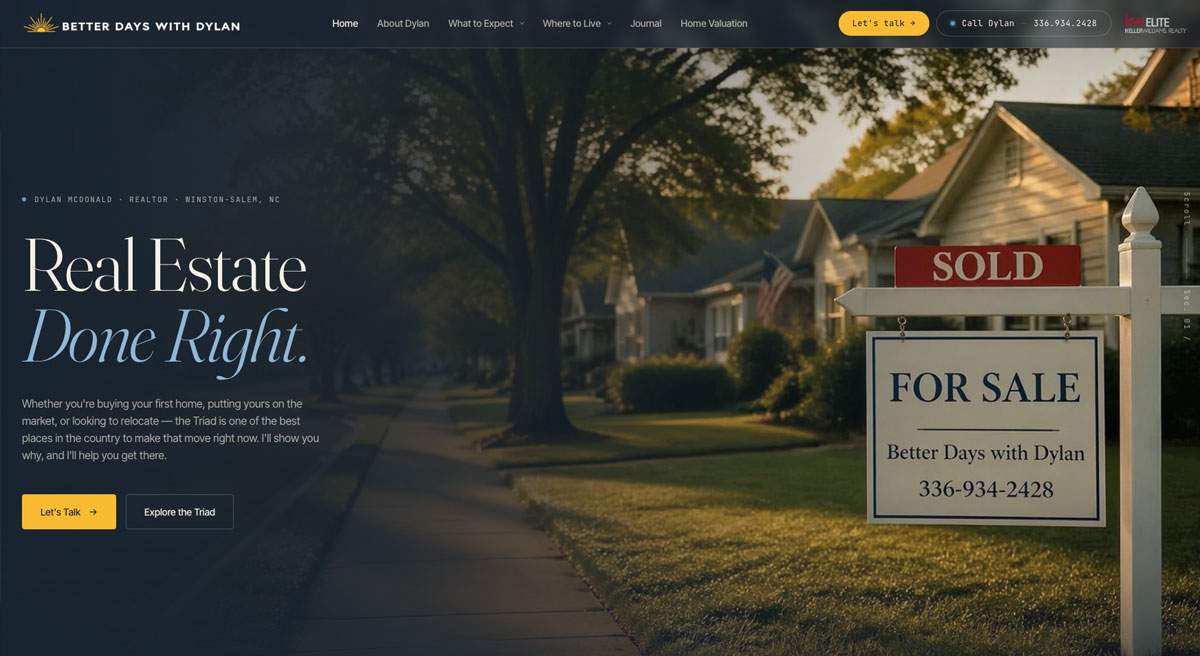
Dylan is a Winston-Salem, NC realtor building from scratch. He wanted a site that worked for him — not one that funneled his leads to Zillow.
We skipped IDX entirely. Instead I built five neighborhood guide pages targeting specific Winston-Salem buyer searches, set up his Google Business Profile and Search Console, handled his MLS and license compliance properly, and built lead capture that goes directly to him.
The result is a site that's actually his — not a re-skin of the same template half the agents in his market are running.
Questions realtors ask.
Do you build sites with IDX search?
Usually no — and I'll tell you why. IDX widgets are designed to route serious buyers OFF your site and into Zillow's, Realtor.com's, or your MLS provider's lead funnel. You pay a monthly fee to send your traffic to your competitors. For most solo agents, the better play is neighborhood guides and local content that ranks for buyer-intent searches, plus a clear way to contact you directly. If you have a specific reason to need IDX, we can talk about it — there are cases where it makes sense.
How is this different from Placester, RealGeeks, or Luxury Presence?
Those are templated SaaS platforms — you're renting one of a hundred layouts that every other agent on the platform is also using. They're priced as ongoing subscriptions ($50-$500/mo) and the site stops working the day you stop paying. With me, you own the codebase, the design is unique to you, and the only ongoing cost is hosting (~$20/mo on Vercel). I'm available for ongoing changes on a retainer or hourly basis if you want — but it's not a forced subscription.
Will my site rank for [my neighborhood]?
If we build neighborhood guide content for it — yes, very likely, especially against the big portals on long-tail searches. Zillow ranks well for raw listings; it's terrible at ranking for nuanced local queries like 'is [neighborhood] safe', 'best schools in [neighborhood]', 'walking score [neighborhood]'. That's the gap. I've done this for one realtor already with measurable ranking gains within 30-60 days.
Can I see an example?
Yes — Better Days with Dylan (bdwdco.com) is a Winston-Salem, NC realtor I built for. Five neighborhood guides, lead capture, full compliance setup. Detailed case study in the blog: building-better-days-with-dylan-real-estate-agent-website.
How long does a realtor site take?
Typically 4-6 weeks from kickoff to launch, depending on how quickly content (your bio, photos, and the neighborhood guides) comes together. I write the neighborhood guides with you — you know the neighborhoods better than I do, so we collaborate on those. Everything else (design, code, schema, compliance) is on me.
What does it cost?
Fixed-fee project, scoped before we start. You'll know the number before any work begins. Pricing varies with the number of neighborhood guides, design complexity, and whether you want extras like a market-update blog setup or a CRM integration. Most solo-agent builds land in the same general range as 12-18 months of a Placester subscription — except you own the site at the end of it.
What if I'm not in your area?
Doesn't matter — real estate sites are platform-independent and I work with clients across the US. All project communication happens over video and async tools. The neighborhood guide strategy works for any local market.
Do you handle hosting and ongoing changes?
Yes. Sites are deployed to Vercel (fast, reliable, ~$20/mo hosting). Ongoing changes — new neighborhood guides, blog posts, design tweaks — can be done ad-hoc, on retainer, or you can take it over yourself if you have a developer. Your codebase, your call.
Thinking about a custom realtor site?
Tell me about your market, what you're running today, and what you wish your site did differently. I'll tell you honestly whether a custom build is the right move — and if it is, what it would take.
Start a conversation