
Custom websites for local businesses.
For contractors, trades, and service businesses that live or die on local search. Built around the way customers actually find you — a page for every service in every town you work, fast enough to hold them, and built to bring in calls instead of just existing.
Your website exists. It's just not doing the job.
Most local businesses end up on one of two kinds of site. The first is an aging WordPress build with a page-builder plugin — slow, a pain to update, and invisible when someone searches for the work you do in the towns you serve. The second is a cheap DIY builder that looks fine but is a brochure: no real local SEO, no schema, no structure for the searches that actually bring in customers.
Both have the same result. You do good work, you get most of it by referral, and your website contributes almost nothing — when it should be one of your best lead sources. Meanwhile the competitor with a faster, better-structured site is the one showing up when someone in the next town over searches for exactly what you do.
The fix isn't a prettier brochure. It's a site built around how local search actually works.
A page for every service, in every town. Fast, and built to be found.
Google answers most local questions by place. People don't search “excavation contractor” — they search “land clearing in [town]” or “site prep near [town].” So I build a site that has a real page for each service and each town you work in, written to speak in the words your customers actually type. That gives you dozens of legitimate front doors into your business instead of one.
Underneath that: a static-first build that loads almost instantly, LocalBusiness schema so search engines know exactly where you work and what for, consistent contact details everywhere, lead capture that comes straight to you, and — if you already have a site — a migration that carries your existing rankings over instead of throwing them away. It's a foundation that keeps paying off, not a recurring tax on your business.
A site that sounds like you
Custom design and copy that matches how you actually talk to customers — not corporate filler, not a template every other shop in your trade is also running. The site reads like your business because it's built around it.
A page for every town you serve
Local search happens by place. Someone types '[service] in [town]', not just '[service]'. I build a dedicated page for each town in your service area so you're actually in the running for those searches instead of invisible.
Local SEO built into the foundation
LocalBusiness schema on every page, consistent name/address/phone everywhere it appears, service pages that name the real jobs people search for, and Google Search Console set up on day one so you can see what's working.
Fast on a phone in a truck
Static-first builds that load almost instantly, even on a weak rural signal — which is how a lot of your customers browse. Slow sites lose people before the page finishes loading, and Google factors that speed into your rankings.
Lead capture that actually delivers
Phone number visible on every page, click-to-call on mobile, and contact forms that send you a real email the moment someone submits — with bot protection that stops spam without making real customers jump through hoops.
A migration that keeps your rankings
Already have a site? Replacing it is where most rebuilds quietly tank a business in search. Every indexed URL gets mapped and redirected so the equity you've earned follows you to the new site instead of dying on launch day.
Two contractors, one playbook.
From a local dirt contractor to a nationwide infrastructure crew — run by the same Texas family. The same approach, scaled to two very different buyers.
B Squared Excavating — Caddo Mills, TX
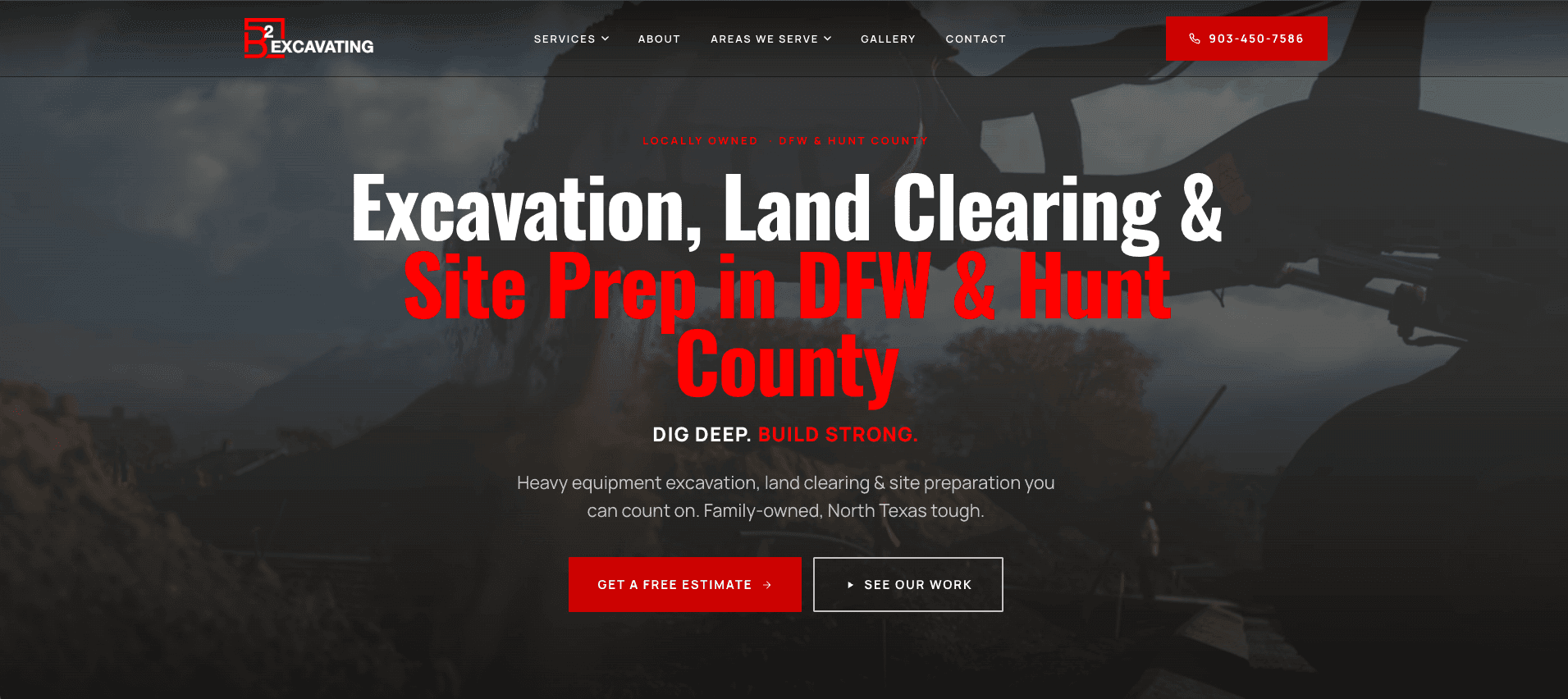
B Squared is a family-owned excavation contractor outside Dallas, working across the DFW metroplex and Hunt County. They came to me with an aging WordPress site that was slow, hard to update, and invisible in search.
I rebuilt it static-first — a page for each of the fifteen towns they serve, a page per service, and LocalBusiness schema wired through every route so Google knows exactly where they work and what for. The old site had indexed URLs I couldn't just throw away, so every changed path got a redirect and the rankings came along to the new site.
And the voice stayed theirs — blue-collar and direct, not corporate filler. It's a site that brings in calls instead of just existing.
American Land Clearing Co. — nationwide
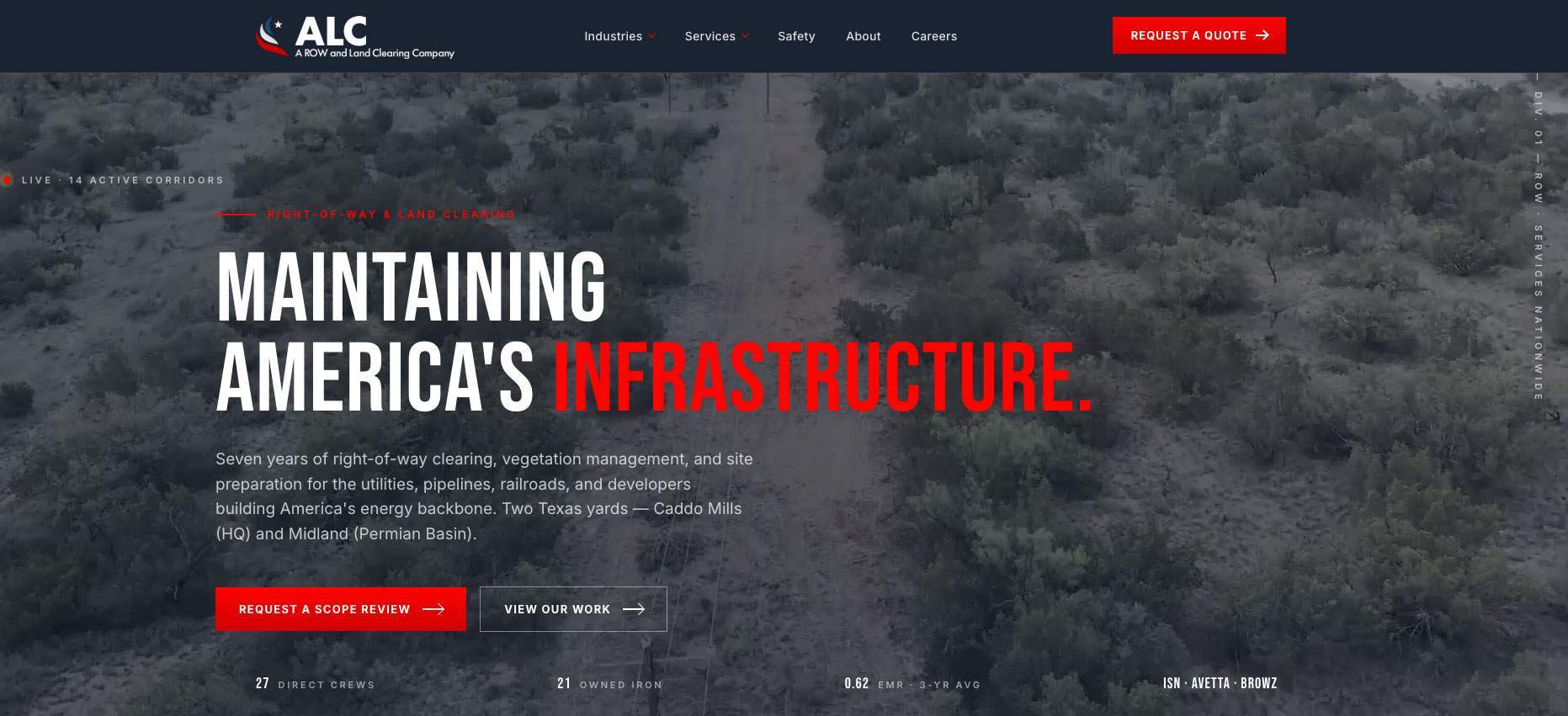
American Land Clearing is B Squared's sister company — same family, a very different business. They clear right-of-way for utilities, pipelines, and railroads nationwide, out of two Texas yards.
The buyer here isn't a homeowner — it's a procurement team that vets you before they call. So the site leads with proof: safety record, crews, owned fleet, and a real page for each industry and service. Twenty-four pages, schema throughout, and a careers pipeline with resume upload that does actual work instead of sitting there as a brochure.
Same fundamentals as the local build — fast, legible to search engines, honest about who the business is — pointed at a national B2B audience.
Questions local business owners ask.
I already have a website. Can you rebuild it without hurting my Google rankings?
Yes — and this is the single most important thing to get right on a rebuild. When you replace a site, every old page address that Google knows about can turn into a dead end, and the rankings you've spent years earning can evaporate. Before I change anything, I map every meaningful URL on your old site and set up permanent redirects so anyone — or any search engine — landing on an old address gets sent to the right new page. The search equity follows the redirect. Done right, a rebuild keeps its momentum instead of resetting you to zero.
Why does a local business need more than one page of services?
Because that's not how local search works. People search by service and by place — 'land clearing in [town]', 'site prep near [town]'. If your site doesn't have a page that's clearly about that service in that area, you're not really a candidate for the search, no matter how good your work is. I build a page per service and a page per town you serve, so the site has dozens of legitimate front doors instead of one.
Why custom instead of Wix, Squarespace, or a WordPress template?
Those are fine for a brochure. The problem is they tend to be slow, they make proper local SEO awkward, and they all look like what they are. A custom static-first site loads almost instantly, has very little that can break, costs almost nothing to host (~$20/mo), and is built around exactly the local searches you want to win. You also own it — there's no platform subscription that takes the site down the day you stop paying.
Can I see an example?
Yes — two, in fact. B Squared Excavating (bsquaredexcavating.com) is a family-owned excavation contractor near Dallas: a takeover of an aging WordPress site, rebuilt static-first with a page for every town and service, LocalBusiness schema throughout, and redirects so the rankings carried over. Its sister company, American Land Clearing Co. (americanlandclearingco.com), is the same playbook scaled up to a nationwide industrial contractor that clears right-of-way for utilities, pipelines, and railroads. Both have full case studies in the blog.
Will this help me show up in the AI answers and Google's answer boxes?
Over time, yes — though it's earned, not switched on. I write the common customer questions directly into the site as plain question-and-answer content and label the whole site with structured data so Google and the AI tools can read it cleanly. That's what makes a site quotable. But the biggest movers for local AI answers are your Google Business Profile, your reviews, and ranking in classic search — the site is built to support all of that, not to fake it.
How long does a local business site take?
Typically 4–6 weeks from kickoff to launch, depending on how many services and service-area towns we're covering and how quickly your content — photos of real jobs, your story, your service details — comes together. I write the service and town pages with you, because you know the work and the area better than I do.
I'm not near you. Does that matter?
No. I work with clients across the US — all project communication happens over video and async tools. The local-search strategy works for any market; it's built around your towns and your services, wherever those are.
What does it cost, and do you handle it after launch?
Fixed-fee project, scoped before any work starts, so you know the number up front. Pricing depends mainly on how many services and service-area pages we build. After launch, the site is on Vercel (fast, reliable, ~$20/mo hosting) and ongoing changes — new service areas, photos, content — can be done ad-hoc or on a retainer. You own the site either way.
Want a site that actually brings in work?
Tell me about your business, the towns you serve, and what your current site is (or isn't) doing for you. I'll tell you honestly whether a custom build is the right move — and if it is, what it would take.
Start a conversation